28. Pertho rune
According to Norse myth, Ymir, while sleeping, gives life to numerous children, and does this solo. It aligns well with the "twin" meaning of his name roots. It seems Ymir contains both twins, including Yami's aspect of Life.
By the way, Auðumbla licks ice blocks and at some point reveals Búri, the ancestor of the Æsir gods, out of the Ice. This story is the first occurrence where a specific time is mentioned: Búri gradually appears from the ice over three days. It indirectly supports our version of the connection between Ymir and the beginning of time, as suggested by comparison with Saturn.
These two branches (and roots?) of Gods and Giants are represented by the upper and lower hands of the rune Pertho:
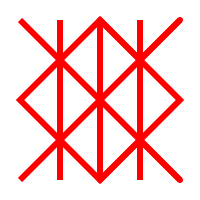
The name and meaning of the Pertho rune are unclear. During the evolution of Elder Futhark, this rune survives only in Old English Futhorc as "Peorþ" (or "Peorð"), and it's missing in Younger Futhark described in Norse sources.
One version of its meaning is a "pear tree" from the Proto-Germanic form perþō from "peru"/"pear".
Some scholars suggest a parallel between Peorþ and Ogham letter Ceirt, meaning "apple tree".
Etymologically, Ceirt can be traced back to the Primitive Irish "Cert" and to Proto-Celtic "kʷerxtā" - "bush".
The Welsh word "perth," meaning "bush," also stems from the same Proto-Celtic root.
If this version is correct, this is the third tree rune name that appears in Elder Futhark, in addition to Eihwaz and Berkana.
From a Runic Alchemical point of view, the tree interpretation is also supported by:
- Sharing the trunk and top bar with the other two tree runes, Eihwaz and Berkana.
- Sharing two bars, top and bottom, with Berkana.
- Vertical symmetry represents the crown and roots.
- Vertical symmetry of all tree runes, which is mirrored in the case of Eihwaz.
Irish version gives us an interesting connection with "ceirtlis" - "cider". And "cider" matches well the Old English rune poem:
ᛈ Peorþ bẏþ sẏmble plega and hlehter
ƿlancum [on middum], ðar ƿigan sittaþ
on beorsele bliþe ætsomne
ᛈ Peorþ is always play and laughter
in the midst of noble warriors
happily sitting together in the beerhall.
The most common alcoholic drink of that period was beer, and wine, both grape and fruit, was also used, but was rarer and more appropriate for elites - it matches the noble status of the warriors mentioned in the poem, while laughter is often a symptom of intoxication.
Peorþ/Peorð word is not attested in Old English sources anywhere outside this specific rune poem. So maybe this word was indeed "imported", same as (fruit) wine?
Another version is a sort of wooden board game or dice, which is also a well-attested part of feast culture. It's interesting to compare this rune poem with the description of supposedly Odin's hall, which we can read in Gylfaginning:
There he saw a great room and much people, some with games, some drinking; and some had weapons and were fighting.
The Old English word "plega" from the runic poem has multiple meanings:
- playing
- a game
- a toy
- a play
- exercise
So in Gylfaginning, we read about all of them! And the most famous Odin's hall full of warriors having fun is Valhalla, so potentially we can connect the Pertho rune with rituals honoring gods and heroes, for example, the practice of libation, if we are looking back to the "cider" version.
Speaking of dice, it's worth remembering about the divination practice of Germanic people described by the Roman historian in his "Germania" around 98 AD:
Augury and divination by lot no people practise more diligently. The use of the lots is simple.
A little bough is lopped off a fruit-bearing tree and cut into small pieces;
these are distinguished by certain marks, and thrown carelessly and at random over a white garment.
In public questions, the priest of the particular state, in private the father of the family,
invokes the gods, and, with his eyes towards heaven, takes up each piece three times,
and finds in them a meaning according to the mark previously impressed on them.
As you see, the fruit-bearing tree is mentioned here, and throwing lots randomly is quite similar on the surface to throwing dice.
Let's look at all the transitions happening in this rune if seen from the Runic Alchemy perspective:
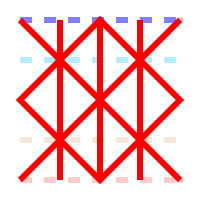
Water comes to the Air and bounces back to the Water.
The same happens to the Fire traveling to the Earth and returning.
But in both cases, they are not the same as they were on departure.
The Water acquires something from the Air and the Fire from the Earth.
I believe this is how worlds of Water and Fire become inhabited - they now contain some shapes.
Surtr, the giant of Fire, is born by the dreaming Ymir, so Fire has its "avatar."
Búri, the early god of the Water, is shaped by Auðumbla and starts the line of all the gods.
Based on this quite complex, multifaceted, and uncertain understanding, I suggest practice for the Pertho below:
-
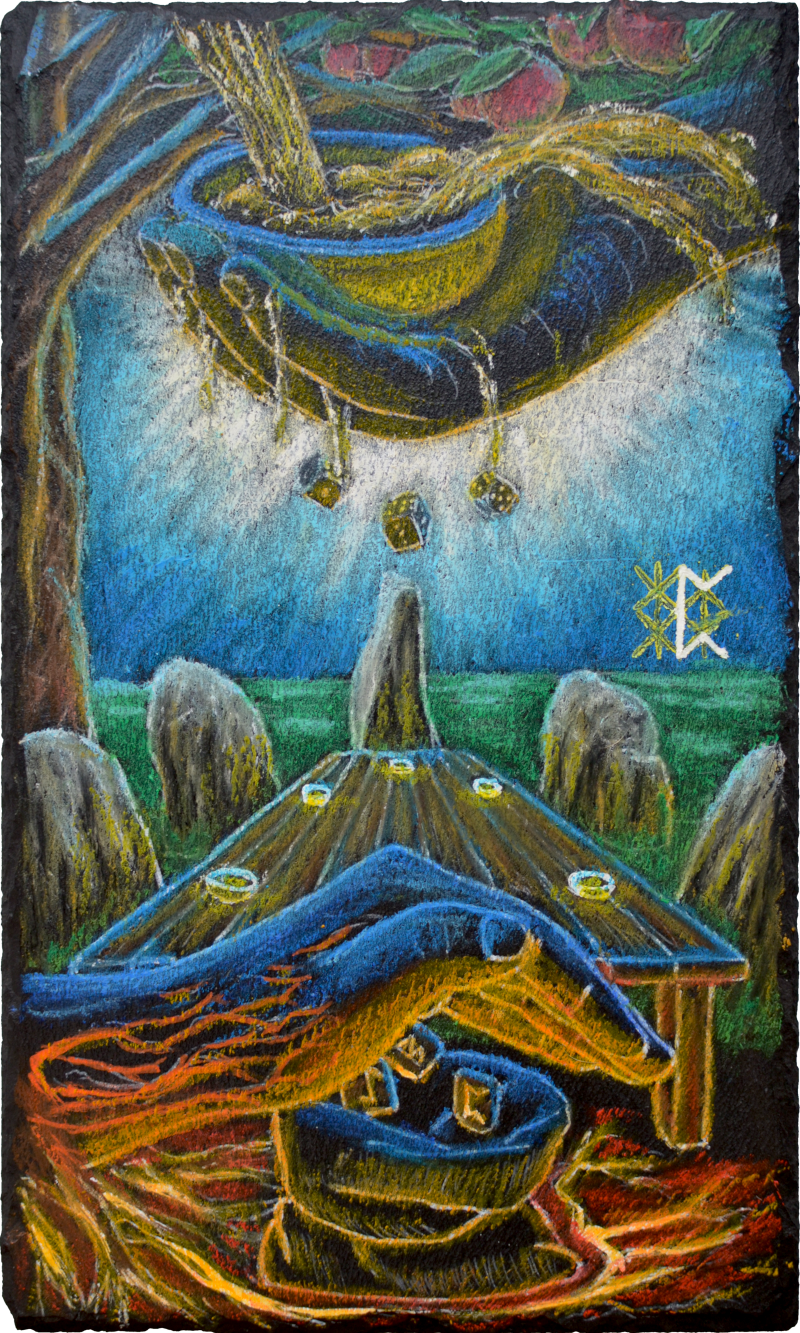
Put your left handful upsidedown to the level of your belly, as if you are covering something with your palm or warming it up above the fire. A bent palm shape will represent a lower angle of Pertho pointing upward.
-
You can think of your left upper arm as a vertical trunk by the left side of the rune
-
And your right palm at the level of your chest, turned upward, as if supporting the bowl or drinking horn from below, will represent the upper angle of Pertho pointing downward.
-
You may feel how the spirit of Fire climbs upward from your left elbow to your palm and then falls back.
-
At the same time, intoxicating liquid is being poured into your right hand, and the stream is deflected from the center of your palm back to the top.
This rune and the final 21 rune in the "Stone" sequence, and as the Thurisaz rune reminded us about the mirrored version of the Kenaz rune from the very beginning of our journey, Pertho shape and gesture are somehow rhyming with the Ingwas rune, but inverted.
This rune teaches us about the flow of events, random, uncertain, unpredictable, but destined, shaping our future, but leaving us the space for choice and freedom, and reminding us that life is a game, and every game has an end at some point.
But our journey is not ending yet here. Three more runes are waiting for us ahead.